
A Case Study: 6.5 x 55 mm Swedish

All news

A Case Study: 6.5 x 55 mm Swedish

A Case study: 6.5 x 55 mm Swedish The 6.5 × 55 mm Swedish, or the 6.5×55 SE (C.I.P) is is one of the most popular all-around rimless bottlenecked rifle cartridges in the world for both target shooters and hunters. The cartridge was developed in 1891 by a Norwegian-Swedish rifle committee to be used in […]

A Case study: 6.5 x 55 mm Swedish

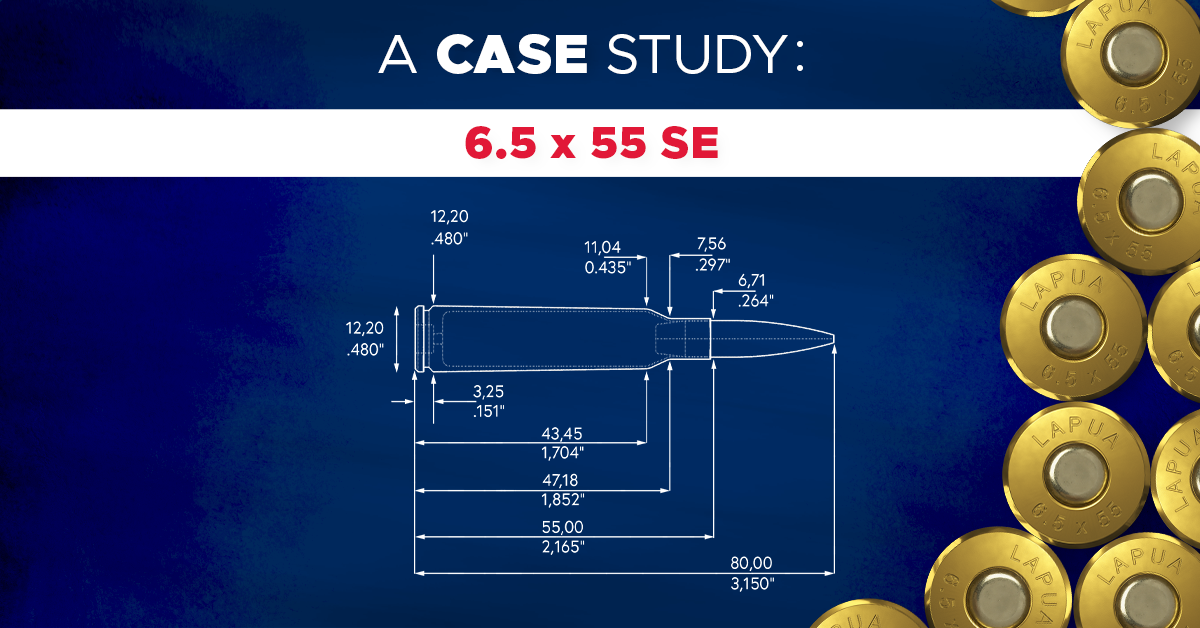
The 6.5 × 55 mm Swedish, or the 6.5×55 SE (C.I.P) is is one of the most popular all-around rimless bottlenecked rifle cartridges in the world for both target shooters and hunters. The cartridge was developed in 1891 by a Norwegian-Swedish rifle committee to be used in the Norwegian and Swedish service rifles (Mauser m/96 in Sweden and the 6.5 x 55 Krag in Norway). At the time, Norway and Sweden had independent armies and the normal procedure was for their respective governments to use the same ammunition and then purchase firearms of their choice. After some discussions and designs back and forth, the 6.5 x 55 mm Swedish cartridge was introduced into use by the nations’ militaries in 1894. The C.I.P. standardized the cartridge as 6.5 × 55 SE in 1984. Lapua A Case Study 6.5x55_SE Despite its large powder capacity, the 6.5 x 55 mm is very flexible. It delivers a flatter trajectory and excellent ballistics, and it has a smaller bullet diameter and less recoil than other full-power service rifle cartridges like the .303 British or the .30-06 Springfield. Though traditionally most used at longer ranges, the 6.5×55 SE cartridge is today extremely popular in competitions from 100 to 800 meters. Practically all rifle manufacturers offer the 6.5×55 SE, and the current bullet technology and selection make it a great universal choice for all types of Scandinavian hunting opportunities from grouse to moose. It is one of the most commonly used rounds in Scandinavian moose hunting and is especially popular in long-range field shooting disciplines. Lapua’s popular 6.5×55 SE case takes the Large Rifle Primer (LRP), and we offer factory-loaded cartridges featuring four different bullet types with bullet weights ranging from 6,5 grams (100 grains) to 10,1 grams (155 grains). ”Old soldiers never die” – the Lapua 6.5×55 SE or the 6.5×55 Swedish case is proof of that. This caliber has long been popular all over Scandinavia, and its characteristics and performance have also been noted by sport shooters and hunters in other parts of the world.
Category

Products Reloading Sport shooting
News

Note: rogue Lapua websites

All news

Note: rogue Lapua websites

Note: rogue Lapua websites Lapua, being a premium quality ammunition brand that’s very sought-after, is at present unfortunately also targeted by sources trying to profit from our brand without any whatsoever agreement with us. Thus, we are stating for the record: Lapua does not sell or ship ammunition or ammunition related products directly to end-users […]

Note: rogue Lapua websites

Lapua, being a premium quality ammunition brand that’s very sought-after, is at present unfortunately also targeted by sources trying to profit from our brand without any whatsoever agreement with us.

Thus, we are stating for the record: Lapua does not sell or ship ammunition or ammunition related products directly to end-users anywhere in the world. Lapua as a company does not own any kind of online store selling ammunition to consumers in any country. Lapua does not deliver directly to any online stores. All our product sales and distribution to consumers go through our worldwide distributors , who in turn handle their transactions typically with local dealers and authorized online stores.

At present, we are aware of e.g. online stores claiming such as lapuabrass-store to deliver our products without any agreement from us or our distributors. THIS IS A FAKE STORE. DO NOT BUY ANY PRODUCTS FROM THEM. If you are unsure, always check that your source is a registered, authorized dealer. Make sure that your dealer has their contact information readily available for you. Do not buy Lapua products from a vendor that claims to ship directly from us. These kind of web shops are scammers.

Any and all types of infringement on our brand and related copyrights will always lead to legal actions on our part.

Category

Company Products

News

A case study: the 9,3×62

All news

A case study: the 9,3×62

A case study: the 9,3×62 The hunting world changed forever in 1905 with the introduction of the 9.3x62mm (or 9.3×62 Mauser) cartridge. The German weapon maker Otto Bock was a well-known name among hunters around the world at the turn of the 20th century. At that particular time, there was a clear need for a […]


A case study: the 9,3×62

The hunting world changed forever in 1905 with the introduction of the 9.3x62mm (or 9.3×62 Mauser) cartridge. The German weapon maker Otto Bock was a well-known name among hunters around the world at the turn of the 20th century. At that particular time, there was a clear need for a new caliber that would meet the demands of the entire hunting world for big game on all continents. Otto Bock designed this rimless, bottlenecked case with the 9.3 mm bullet to fit the Mauser 98 (Gewehr 98) bolt-action lock frame. The G98 was making a strong name for itself as a military rifle, and several European hunters as well as settlers in Africa often opted for military weapons for their reliable functioning.

Bock understood the significance of this and also took into account that several African colonial governments banned the use of military weapons and calibers for hunting. The 9.3mm solution had never been used in military applications, so it immediately gained widespread popularity in both African and European hunting. The North American hunting culture has been influenced by several European arms manufacturers who have sold hunting rifles in this caliber for big game hunting in North America, and the 9.3x62mm cartridge has taken a clear foothold in hunting both in Canada and the United States.

The cartridge is not a large cartridge in terms of external dimensions, but the size of the very widely known .30-06 Springfield and even looks similar to it. The caliber was C.I.P. approved in June 1984.

The first cartridges were loaded with hunting bullets weighing 18.5 g / 285 grains with a muzzle velocity of 655 m/s (2,150 fps). Some time later, solid bullets used in Africa and lighter lead core bullets were introduced. Over the past twenty years, the bullet range has continued to expand with today’s lead-free solutions as well as lightweight training bullets.

The 9.3×62 cartridge generates in practice around 3,500 Joule (787 lbf) of energy at a hundred meters / yards, adequate for all non-dangerous big game all over the world. Thanks to its power and a wide range of rifles to choose from, the 9.3×62 has achieved a significant role in Nordic moose hunting and Central-European driven wild boar hunts. The 9.3×62 enjoys particular popularity among dog hunters, where the relatively short-barreled rifles and short firing distances bring out the power and other best aspects of the cartridge. The growth of the bear population and with it the increase of bear hunting has also opened doors for the 9.3×62 and clearly increased its popularity in the Northern Hemisphere.

Although many African countries have set a minimum caliber of .375 for dangerous game, many countries have made an exception for 9.3×62 for use when hunting local dangerous game.

Lapua offers the world’s best case for this caliber for reloaders as well as three different bullet options; the 18.5 gram / 285 grain SP MEGA, the 16.2 gram / 250 grain Naturalis lead-free projectile and the 12.0 gram / 185 grain Open Tip bullet. All bullet options are also available as factory-loaded ammunition.

Category

Products Reloading

News

Case Study: the 6,5×47 Lapua

All news

Case Study: the 6,5×47 Lapua

The 6,5×47 Lapua brass case We begin a new blog post series: The Case Studies! These posts will feature our well-known cartridge cases and the background behind them. The first case to be featured is the 6,5×47 Lapua. The 6,5×47 Lapua is still a relatively new caliber on the market. Lapua introduced its second title […]

We begin a new blog post series: The Case Studies! These posts will feature our well-known cartridge cases and the background behind them. The first case to be featured is the 6,5×47 Lapua.

The 6,5×47 Lapua is still a relatively new caliber on the market. Lapua introduced its second title caliber in early 2006 and reached its C.I.P. approval in May of the same year. The idea for the caliber was to make a design that can meet the 6 mm BR dominance in 300 m shooting, but also gain a foothold in other sport shooting and precision-demanding hunting.

The 6.5 mm bullet diameter was chosen for many different reasons, which at the time generally gained popularity all over the world. The diameter of the base as well as the loading length were copied from the .308 Winchester caliber, as it was thought that the existing armament would serve the newcomer practically by simply changing the barrel.

Lapua ran an extensive test program between Large Rifle and Small Rifle primer pockets and eventually ended up choosing the SR primer pocket for the new title caliber. This solution was the first of its kind in history when it comes to this cartridge class and performance level.

Even though the size of the brass is modest, the cartridge was intended to become a top performer, both in terms of muzzle velocity and hit. A 4,350 bar maximum pressure was recorded in the CIP, which is 550 bar more than for a 6,5×55 SE cartridge. The great hit potential of the caliber was achieved through smart and modern cartridge design, utilizing ideas from existing high-performance cartridges.

6,5x47 Lapua brass case

Despite its small case size and limited powder volume, the 6.5×47 Lapua case also serves as an excellent platform for today’s long and heavy high BC bullets.

The 6,5×47 Lapua represents an average cartridge size and is very proportional to the .260 Rem and 6.5 Creedmoor cartridges. In terms of its muzzle velocities, the caliber ranks between the two calibers, but it has a better accuracy potential than the other two. Even with relatively moderate charges, a 8.0 g / 123 gr bullet can reach a muzzle velocity of up to 900 m/s / 2,953 fps.

At the starting point of the design, i.e. in 300 m shooting, this round has achieved a full 600 points several times, so the caliber accuracy can also be compared to a 6 mm BR cartridge.

In competitive shooting, the 6,5×47 Lapua has achieved success in 600 m competitions, PRS and silhouette shooting, as well as in long-range sniping competitions. The caliber has indeed achieved a reputation as a very universal match round. It can be utilized at short distances, beat records at medium distances, and be a thorn in the side of larger traditional sniper calibers at long distances and ELR.

The 6.5mm bullet range is huge, to say the least. There is definitely something suitable for everyone and everything in this caliber. Very comprehensive and extensive reloading data is available by Vihtavuori and Hodgdon, among others.

Based on all the above mentioned advantages and being easy and comfortable to shoot, we recommend the caliber for those who are serious about sport shooting, regardless the discipline. We also don’t want to forget hunters who have the skill to shoot a hunting projectile where they want it, take down the game effectively, and save themselves valuable game meat. Whether you’re hunting hoofed game or tree-top birds requiring utmost precision, this is the cartridge for you.

In addition to the world’s highest quality cartridge case, Lapua offers 5 different factory-loaded cartridges for different uses:

We also offer a dozen 6.5 mm bullet options for home reloaders to choose from to make your perfect 6.5×47 Lapua.

Category

Products Reloading Sport shooting

News

Lapua Club changes in June 2021

All news

Lapua Club changes in June 2021

The Lapua Club content and layout will change in June 2021, also resulting in changes to the services we offer in the Lapua Club. Beginning June 1st, 2021, the Lapua Club no longer offers prizes for registered products. Lapua Club members have been notified of the change earlier by email. Stay tuned for other new […]

The Lapua Club content and layout will change in June 2021, also resulting in changes to the services we offer in the Lapua Club. Beginning June 1st, 2021, the Lapua Club no longer offers prizes for registered products. Lapua Club members have been notified of the change earlier by email. Stay tuned for other new developments!

Category

Company Products

News

Introducing: New factory-loaded hunting cartridges

All news

Introducing: New factory-loaded hunting cartridges

We are excited to bring forth two new top-performance hunting rounds for two very popular calibers, the .223 Rem. And the 6.5 Creedmoor. .223 Remington with the Lapua Naturalis bullet .223 Remington, one of the most popular cartridges, is now available with the 3,2 g / 50 gr Lapua Naturalis hunting bullet. This is the […]

We are excited to bring forth two new top-performance hunting rounds for two very popular calibers, the .223 Rem. And the 6.5 Creedmoor.

.223 Remington with the Lapua Naturalis bullet

.223 Remington, one of the most popular cartridges, is now available with the 3,2 g / 50 gr Lapua Naturalis hunting bullet. This is the perfect cartridge choice for anyone looking for performance without wasting any meat.

The .223 Rem started out as a varmint round in the 1950ies but it has come a long way since then to become a viable choice for small game and even small deer hunting. Today, we are proud to introduce one of the most modern and innovative .223 Rem cartridges for this purpose with our .224 Naturalis projectile. It has everything a demanding small game hunter needs, superb accuracy and top-of-the-class terminal ballistic performance. As with all our Naturalis projectiles, it comes with our new AirLock technology, securing that the cartridge performance is secure from dust and outside moisture changes.

The technology of the Naturalis bullet allows for a perfect mushrooming effect, expanding the bullet diameter up to double the original, creating an adequate wound channel. With exceptional performance and amazing penetration capabilities up to 100 % of retention weight, this factory-loaded cartridge is a must-have for any .223 Rem enthusiast wanting to make fond new hunting memories.

6.5 Creedmoor with the Lapua MEGA bullet

While the 6.5 Creedmoor was originally designed for long range target shooting, it has during its short lifespan already gained a reputation as a viable hunting caliber. Lapua’s 6.5 Creedmoor range of factory-loaded cartridges is now complemented with the addition of the 6,5 mm 10,1 g / 156 gr Soft Point MEGA projectile. This hunting bullet is known for an amazing accuracy almost matching bench rest bullets, and it has established its reputation as an excellent moose hunting bullet in the Nordic countries for decades. The reliable MEGA locking holds the bullet jacket and core tightly together, even in a hard bone hit. With the soft recoil and range performance of the 6.5 Creedmoor combined with our top components, we expect this cartridge to become a favorite with red deer, fallow deer and white-tailed deer hunters.

The new Lapua cartridges will be hitting the markets in the summer of 2021.

Category

Products

News

New match grade ammunition for 6.5 Creedmoor and .260 Remington

All news

New match grade ammunition for 6.5 Creedmoor and .260 Remington

While the 6.5 Creedmoor continues to increase in popularity in competitive shooting, there is also a growing demand for a match solution for .260 Remington. Lapua has risen to the occasion and presents new factory-loaded cartridges designed to conquer the market and outperfom the competition at ranges up to 1,000 m/yds and even beyond. The […]

While the 6.5 Creedmoor continues to increase in popularity in competitive shooting, there is also a growing demand for a match solution for .260 Remington. Lapua has risen to the occasion and presents new factory-loaded cartridges designed to conquer the market and outperfom the competition at ranges up to 1,000 m/yds and even beyond.

The rounds are loaded with the 8,8 gram / 136 grain Scenar-L bullet. Introduced in 2013, it has ever since become a staple midrange and long range match projectile in 6.5 mm applications.

Both calibers are C.I.P. approved. Even if the .260 Rem. cartridge has a slightly shorter max overall length compared to the 6.5 Creedmoor round, it still performs similar to the latter in terms of muzzle velocity and hit accuracy. The biggest difference between the two is that the 6.5 Creedmoor case is Small Rifle Primer while the .260 Rem. has a Large Rifle Primer pocket.

If you are looking for a podium finish in PRS, silhouette or other accuracy disciplines, Lapua’s new match grade rounds are guaranteed to help you reach your peak potential. These cartridges will also meet the high demands of Military / Law Enforcement professionals.

The new Lapua cartridges will be hitting the markets in the summer of 2021. Flight Trajectory data coming soon!

Category

Products

News

The story of .338 Lapua Magnum, pt 1

All news

The story of .338 Lapua Magnum, pt 1

In this two-part feature, we share the background behind the legendary .338 Lapua Magnum and how it came to be a cartridge from Finland, even though the idea was born on another continent. The .338 Lapua Magnum caliber originates back almost forty years to 1982, when the .338/416 cartridge was developed for the United States […]

In this two-part feature, we share the background behind the legendary .338 Lapua Magnum and how it came to be a cartridge from Finland, even though the idea was born on another continent. The .338 Lapua Magnum caliber originates back almost forty years to 1982, when the .338/416 cartridge was developed for the United States military purposes. Officially, the project was to develop a target rifle and cartridge for 1000 yards, but in reality the purpose was more likely to develop a 1500 meter sniper rifle. The .300 Winchester Magnum and other commercial cartridges did not meet penetration requirements, so the search for a heavier caliber with better ballistics was on. The result was a new wildcat cartridge that was originally formed from a necked down .378 Weatherby Magnum case, and finally from the .416 Rigby case. The new cartridge was known as the .338/416 or 8.58×71. Lapua finished development of the first bullets and cases for the .338/416 cartridge in 1985. Its first .338 caliber projectile was the B408, which in 1985 looked more like a D46 bullet on steroids than the Lock Base type currently produced. In 1986, the .338/416 cartridge with a Lapua bullet and case won the 1,000 yard navy rifle competition in Quantico, Virginia. In spite of that, the U.S. military selection criteria went in a different direction. At that point, Lapua was left more or less alone with the new caliber cartridge, still management decided to continue product development. This resulted in specifying the measurements, and the cartridge was named the .338 Lapua Magnum. The .338 Lapua Magnum was slightly different than the original .338/416 case. Case and chamber dimensions were modified, along with the interior structure of the case to withstand higher chamber pressures than the .338/416 design. The .338 Lapua Magnum had arrived. Continued in part 2!

Category

Products Reloading Sport shooting

News

Lapua Ballistics Tips: Stability Estimation

All news

Lapua Ballistics Tips: Stability Estimation

(Click here for the Lapua Ballistics Tips page and previous tips) Some basics about bullet accuracy and stability estimation Stability is an essential part of bullet accuracy. Stability is affected by several factors, the most important factors being barrel twist rate and the length of the projectile. To a lesser degree it is also affected […]

(Click here for the Lapua Ballistics Tips page and previous tips)

Some basics about bullet accuracy and stability estimation

Stability is an essential part of bullet accuracy. Stability is affected by several factors, the most important factors being barrel twist rate and the length of the projectile. To a lesser degree it is also affected by the bullet shape, velocity and environmental conditions. You can estimate bullet stability during the flight path with the stability estimator function in Lapua Ballistics. In this article, we will explain bullet stability to a high detail and how to use Lapua Ballistics as a tool to understand it.

What is barrel twist rate?

Twist rate is defined as the length of one full turn of the bullet (360 degrees) in inches or millimeters in the barrel. E.g. 1:10” means that the bullet makes one full turn over the distance of 10 inches. You can measure the twist rate of your rifle barrel by marking e.g. a cleaning rod with a flag made of adhesive tape, and measuring the distance where the flag rotates 360 degrees. Make sure that the cleaning rod follows exactly the lands in the barrel.

What happens if the bullet is too long compared to the twist rate?

If the bullet is too long compared to the twist rate, it will be unstable and may start to wobble or even turn completely crosswise. For the shooter, this translates as poor accuracy and oval or ”keyhole” shaped holes in the paper target. An overstabilized projectile does not follow exactly the trajectory of the curved flight path but flies slightly nose up. Technically speaking, the axis of the bullet does not follow the tangent of the trajectory. This increases the air drag and shortens the flight range. An unnecessary high rotation speed also intensifies the adverse effect of smaller shape and symmetry defects of the projectile. Lapua Ballistics Bullet stabilization explained

How to increase bullet stability

The stability of a bullet can be increased by the following factors (roughly in the order of importance):
  1. Tighter (shorter) twist rate of the barrel
  2. Shorter bullet
  3. High altitude (lower air density)
  4. High temperature (lower air density)
  5. Low air pressure (lower air density)
  6. High humidity (lower air density. Yes, water vapor is less dense than air!)
Lower air density means less aerodynamic forces affecting the bullet so it remains stable easier.

Stability estimation – the theory

Traditionally, bullet stability is estimated by using quite simple equations like the Miller and Greenhill equations. Lapua Ballistics estimates the bullet stability by using both dynamic stability ’Sd’ and gyroscopic stability ’Sg’ during the full bullet trajectory. The value of the stability calculator is more in comparing different combinations with each other (twist rate, bullet to be used, muzzle velocity, environmental conditions, etc.) than trying to say simply if a bullet is stable or unstable. Gyroscopic stability Sg means the ability of a rotating object to resist the change of its rotating axis. Sg is quite easy to calculate and its value at the muzzle has to be absolutely over 1.0 for a bullet to be stable. In practice some safety margin is needed there so the recommended minimum value is 1.4. Values clearly over 2.0 are unnecessary high because an overstabilized bullet has higher air drag due to the ”nose up” flight position and is more critical to small imperfections in the bullet shape and symmetry. Gyroscopic stability increases with flight time/distance because the rotational speed of the bullet does not decrease as fast as the forward velocity. Dynamic stability Sd means the ability of the bullet to decrease a wobbling motion caused by an internal or external effect. In a dynamically stable bullet, the wobbling decreases with the time/distance and in a dynamically unstable bullet the wobbling increases with the time. Sd is much more difficult to evaluate than Sg and it needs 6 DOF calculations. Lapua Ballistics is one of the very few ballistics software solutions that is capable of utilizing this and possibly the only one completely free of charge. Most software are capable of estimating stability only by Sg which is usually reasonable good enough for short distances but not to long distances and to the transonic region – where Sd is the main factor for stability. The vertical axis of the stability curve expresses Sg and the horizontal axis Sd. The favorable stability region is expressed as light blue but high quality bullets often retain the stability also in the dark blue region. Dynamic stability is affected by e.g. the bullet length and shape and the positions and distance between the center of mass (cm) and the center of pressure (cp). The distance between cm and cp is very important because it defines the aerodynamic moment vector that tries to turn the bullet crosswise. Air density is also important, the stability is better in a higher altitude and warm weather. The grooves (made by the lands in the barrel) on the bullet surface slightly affect the dynamic stability and decelerate the rotating speed faster compared to a smooth surface. Dynamic stability is usually the problem only at long distances and in the transonic region. Stability is not an ON/OFF phenomenon, so Sg and Sd basically describe the tendency or risk for unstability. For that reason the graph in Lapua Ballistics is not black and white but light/dark blue. The bullet can fly – and often does – fly stable and accurate also far inside the dark blue region. As a rule of thumb, we can say that at the later (number of 100 m/yds markers) and in the more upper direction the line exits the light blue region, the better the bullet can resist external forces trying to make the bullet wobble, meaning that the stability and accuracy potential is better.

How to read the stability calculator in Lapua Ballistics

Simple guide for ensuring bullet stability

  1. The target for the gyroscopic stability value Sg at the muzzle is between 1.4 and 1.8. Never go below 1.2 and avoid values clearly over 2.0. This is a good guide for both short range and long range bullets. For most shooters this is enough and in that case, you don’t have to worry about the dynamic stability Sd.
  2. When you shoot long (over 600 m/yds) and extremely long (over 1 km/mi) ranges, you also need to pay attention to the dynamic stability. The stability curve should turn as late as possible (no. of distance markers) and only a little to the left. If the curve turns 90 degrees to the left it means a higher risk of unstability than if the curve turns only 45 degrees to the left. The stability curve of high BC long range bullets always turn clearly to the left.
  3. Long and sharp-nosed VLD bullets (Very Low Drag) may be problematic in the transonic region. Shorter projectiles tackle this problem easier but on the other hand they reach the transonic region earlier because of a lower BC. Transonic region stability can be improved by a tighter twist rate but this may have other undesired effects to the accuracy in general.

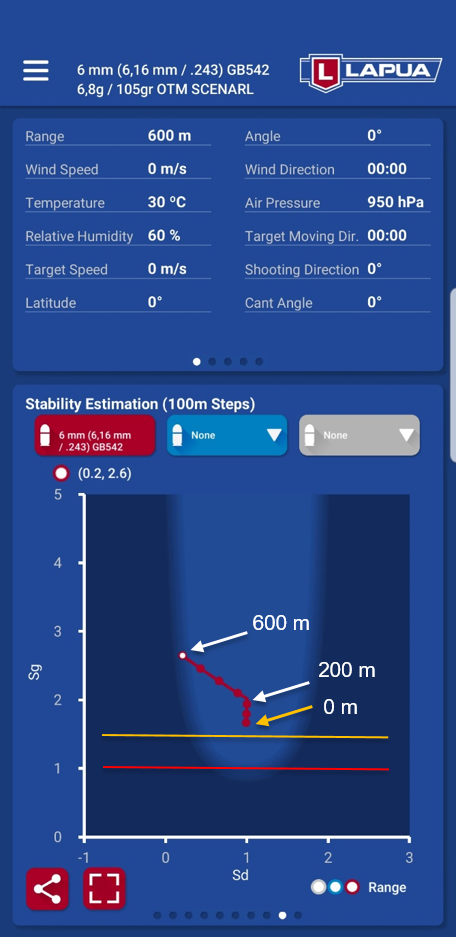
Example of bullet stability estimation in Lapua Ballistics:

Lapua Ballistics Stability Estimation 1
  • Gyroscopic stability Sg is expressed on the y-axis (0 – 5).
  • Dynamic stability Sd is expressed on the x-axis (-1 – +3).
  • Maximum values are expressed also as numerical values in the top left corner (here Sd = 0,2 and Sg = 2,6).
  • On the line, there are markers at each 100 m/yds starting from 0 m/yds but the line is actually calculated and shown in 10 m/yds intervals.
  • The safe stability region is expressed as a light blue area. In the dark blue region the risk for unstability is increased but it doesn’t mean that the bullet is unstable. Only the bullet ability to correct external disturbances (e.g. flurry or transonic area disruption) is reduced.
  • Gyroscopic stability at the muzzle (0 m/yds, first marker) should be at least over 1.0 (red line) and preferable over 1.4 (yellow line).
  • Gyroscopic stability increases with the distance (here 1.7 -> 2.6) because the bullet retains its rotational speed better than forward velocity.
  • Dynamic stability starts to weaken after 200 m/yds but in this case it is not dramatic and the bullet remains in the safe region up to 600 m/yds.

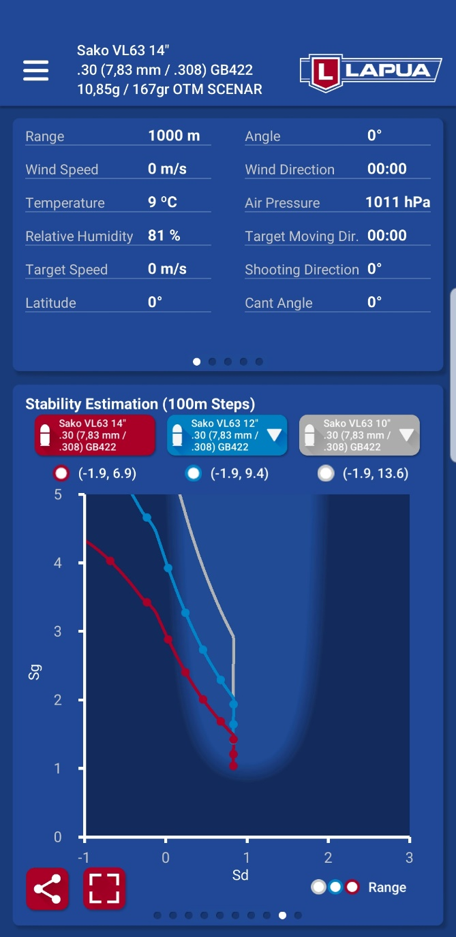
Effect of twist rate in .308 Win, example:

Lapua Ballistics Stability Estimation 308 Win
In this graph you can see the effect of the twist rate to gyroscopic and dynamic stability in a .308 Win. rifle with the 10,85 g / 167 gr GB422 Scenar bullet. This OTM bullet is mainly designed for short and medium ranges – up to about 600 m/yds.
  • The 1:14” twist rate (red curve) is too slow (i.e. long) for this combination. Gyroscopic stability at the muzzle is too low (first red dot) ca. 1.0. There is a high risk for the bullet to be unstable already at the muzzle.
  • The 1:12” twist rate (blue curve) is appropriate for this combination. Gyroscopic stability at the muzzle (first blue dot) is good, ca 1.4. The bullet travels the first 500 m/yds in a safe region and does not turn strongly left even after 500 m/yds. The bullet has good presumption to fly stable and accurate to long ranges.
  • The 1:10” twist rate (gray curve) is slightly too fast for this combination. Gyroscopic stability at the muzzle (beginning of gray curve) is slightly too high, ca. 2.0, but the bullet likely works fine and shoots accurate. But the bullet is spinning unnecessary fast and may be susceptible to adverse effects of small imperfections in shape or symmetry. A good combination, but maybe not the optimal one.
  • The exact Sg and Sd values can be seen in the trajectory table if Sg and Sd are selected as columns to be visible.
  • Please note that the software may calculate the stability values for longer distances than the shooting distance so the last marker may not be the actual shooting distance.
  • This feature is available only for Lapua bullets and cartridges because the details of bullet structures (e.g. moments of inertia, center of gravity, etc.) are not available for other bullets.

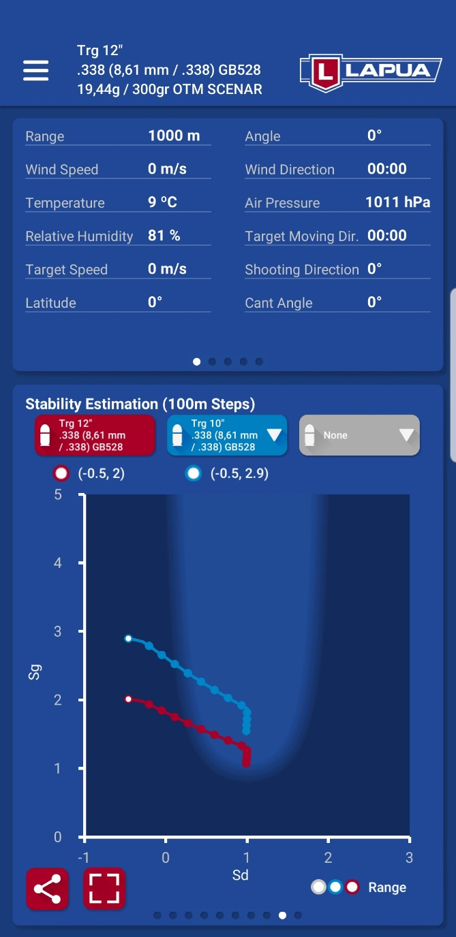
Effect of twist rate in .338 Lapua Magnum, example:

Lapua-Ballistics-Stability-Estimation-4
In this graph you can see the effect of twist rate to gyroscopic and dynamic stability in a .338 Lapua Magnum rifle with the 19,44 g / 300 gr GB528 Scenar OTM bullet.
  • The 1:12” twist rate (red curve) is too slow (long) for this combination. Gyroscopic stability at the muzzle is too low (first red dot), ca. 1.0. There is a high risk for the bullet to be unstable already at the muzzle. This combination is known to be in the limit of appropriate function – sometimes it works, but usually not.
  • The 1:10” twist rate (blue curve) is appropriate for this combination. Gyroscopic stability at the muzzle (first blue dot) is good, ca. 1.5. The bullet travels the first 800 m/yds in a safe region. Even when it exits the safe region at 800 m/yds, this bullet is well known for extremely good accuracy up to 1 500 m/yds and over. It is typical for all long high B.C. bullets that the Sd turns strongly to the left and exits the safe region.

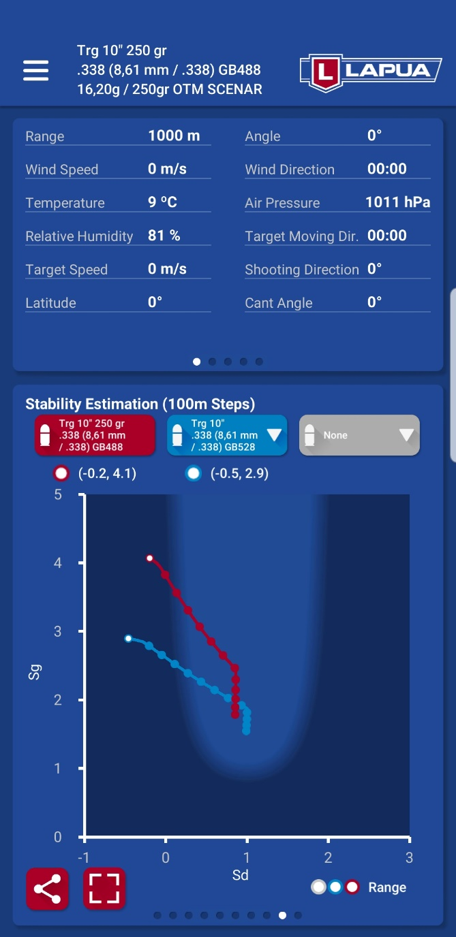
How bullet length affects the stability

Lapua Ballistics Stability Estimation Lapua-Ballistics-Stability-Estimation
In this graph you can see the effect of bullet length to gyroscopic and dynamic stability in a .338 Lapua Magnum rifle with a 1:10” twist rate.
  • The shorter 250 gr GB488 Scenar (red graph) retains its stability better than longer 300 gr GB528 Scenar (blue graph), but reaches the transonic region a little earlier than the ballistically better 300 gr bullet. You can compare differences in bullet velocity and energy in their respective graphs and trajectory table.
  • If you can see a clear wave pattern in the trajectory curves, it is also an indication of potential instability. The most likely reason for this is a too slow (long) twist rate that doesn’t stabilise the bullet but allows for it to wobble from side to side or even turn crosswise. In this case, shoot paper targets to check that the holes are round and the accuracy is good enough for your purpose.

Extreme examples

Lapua-Ballistics-Stability-Estimation
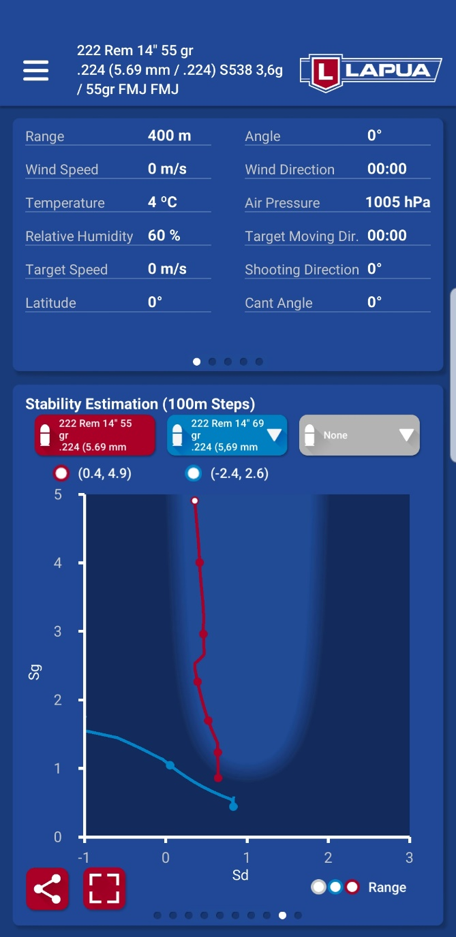
In this graph you can see two .222 Rem. caliber bullets, both shot with a 1:14” twist rate rifle.
  • The .222 Rem is designed for short 55 gr FMJ-bullets (red curve). Even if the gyroscopic stability is dangerously low in the beginning (ca. 1.0), it increases rapidly and this short flat base bullet is not susceptible to wobbling. This combination is in practise a well-proven small game cartridge.
  • The 69 gr Scenar bullet (blue curve) is much too long for this twist rate. Gyroscopic stability starts from a very low value and also the dynamic stability starts to weaken significantly immediately. This bullet will likely not be stabilized at all and the accuracy potential is very low and likely the holes in a paper target are oval – even at 100 m/yds.

Temporary loss of stability

Lapua-Ballistics-Stability-Estimation
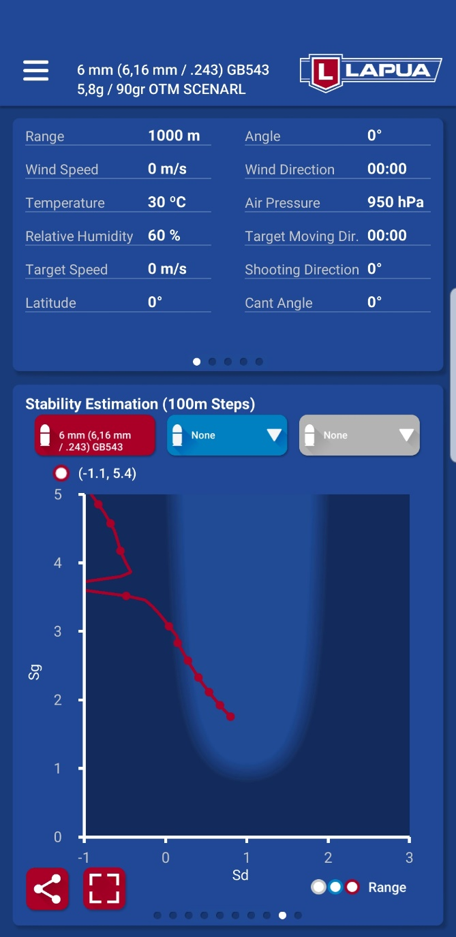
In this graph you can see a temporary loss of stability at a distance of 650 – 850 m/yds with a 6 mm 90 gr GB543 Scenar bullet. In this case the projectile reaches the transonic area at the distance of 700 m. Stability will revert soon after that and the bullet likely continues a stable flight without a loss of accuracy. This is also helped by the high gyroscopic stability value of over 3.5.
  Lapua Ballistics 6 DOF is the only free of charge consumer software capable for these kind of studies. For those interested to understand the theory behind bullet stability even further, we recommend the following reading:
  • McCoy, R. Modern Exterior Ballistics, the Launch and Flight Dynamics of Symmetric Projectiles. Schiffer Publishing, 1999
  • Bryan Litz, Applied Ballistics For Long Range Shooting 3rd Edition
  • Sailaranta, T. Studies on Unmanned Atmospheric Flight. Doctoral Thesis. Aalto-University, Helsinki, Finland.
Our next tip will feature the use of spin drift adjustment. Stay tuned! Go to Lapua Ballistics main page Back to news and updates

Category

Products

News

Ultimate Reloader testing Lapua 6.5 Creedmoor cases

All news

Ultimate Reloader testing Lapua 6.5 Creedmoor cases

Gavin at Ultimate Reloader did a great piece on our large rifle primer (LRP) and small rifle primer (SRP) 6.5 Creedmoor cases. Watch full video below!

Gavin at Ultimate Reloader did a great piece on our large rifle primer (LRP) and small rifle primer (SRP) 6.5 Creedmoor cases. Watch full video below!

Category

Products Reloading Sport shooting

News